GOC publishes 2025 UK Optical Education report
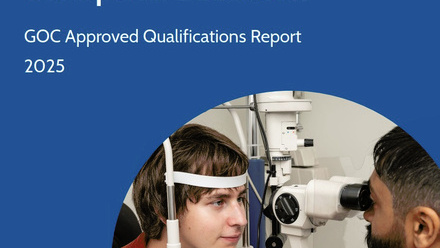
We have published our UK Optical Education 2025 Report for GOC approved qualifications, which provides an analysis of education and training of optical students and trainees and a commentary on sector developments.
Each year, as part of our Quality Assurance and Enhancement Method (QAEM), all providers of GOC approved qualifications are required to submit information relating to qualification changes, changes to qualification delivery and/or assessment (including risks to delivery), lessons learned, and good practice.
Under the Opticians Act 1989, we have the power to approve and quality assure qualifications leading to GOC registration or speciality registration, which includes all elements of training, learning and assessment that a provider must deliver for its students to successfully complete their studies and join the GOC register.
We analysed the information provided to identify:
-
updates regarding key events and changes at qualification level;
-
current risks and issues relating to individual approved qualifications(s);
-
themes, strengths, and risks within the optical education sector;
-
the diversity of students within the optical sector;
-
examples of good practice and lessons learnt; and
-
ways the GOC’s quality assurance activities could be developed.
During 2023/24, there were a total of 37 qualifications delivered across 4,930 optical students.
The report reflects on the continuous changes happening in the optical education sector. Nearly all education and training providers have adapted to the GOC’s new education and training requirements (ETR) for entry-level qualifications. These changes were introduced to ensure the qualifications we approve are fit-for-purpose, with the first ETR cohorts expected to graduate in the Spring of 2027. We will commission research to measure the effectiveness of the new requirements.
Now that implementation of the ETR has advanced, we are seeing significant interest in new qualifications in both optometry and dispensing optics, with some providers aiming to welcome their first intakes in September 2026. Government decisions on funding for apprenticeships are likely to increase qualifications in dispensing optics. However, progress in developing an optometry apprenticeship appears to have stalled over the last year.
Change is also forthcoming to the GOC’s registration process for international applicants. Following public consultation, we have developed two alternative routes to registration for such applicants including direct entry to the register (subject to final GOC checks) and successfully completing a GOC approved qualification which meets the ETR. We have carried out an analysis of potential equivalent non-UK optometry qualifications and qualification systems to identify which could potentially offer direct entry. This analysis will be published shortly.
This year we have changed the format of this report to focus on five high-level outcomes that we wish to achieve. Our data analysis and commentary on sector developments are organised around each of these outcomes, rather than separate chapters for each eyecare profession, as was the case in previous years. We will continue to refine our approach for future editions of this report based on feedback received.
The five high-level outcomes are:
-
Outcome 1 – Sufficient students to meet patient needs
-
Outcome 2 – Qualifications equip registrants to deliver safe and effective eye care for all
-
Outcome 3 – High levels of student satisfaction and welfare
-
Outcome 4 – A strong, innovative and resilient sector
-
Outcome 5 – Post-registration qualifications support registrants to deliver a wide range of eye care services in communities
We also asked providers to supply enhanced equality, diversity, and inclusion data in various areas including admissions, progression and attainment. This additional information reflects the PSA’s strengthened expectations concerning Standard 3 introduced in 2019, which considers whether regulators understand the diversity of their stakeholders and ensure that their processes do not discriminate unfairly.
For more insights, see the UK Optical Education 2025 Report.