
Quality assurance and enhancement methods
The GOC has been granted powers to undertake quality assurance and enhancement (sections 12 and 13 of the Act), including the approval, of qualifications leading to registration. In order to do this, the GOC uses various quality assurance tools and methods to provide assurance that education standards are being met.
Our quality assurance and enhancement method describes how we will gather evidence to decide whether a qualification leading to registration with the GOC meets our outcomes for registration and standards for approved qualifications, in accordance with the Act.
These are four key methods of assurance and enhancement that together will provide insight as to whether a qualification continues to meet our outcomes and standards:
-
periodic review (of approved qualifications);
-
annual return (of approved qualifications);
-
thematic review (of standards); and
-
sample-based review (of outcomes).
Periodic review
All approved qualifications, once approved, are subject to periodic review. Periodic reviews consider whether an approved qualification routinely meets the outcomes and standards set out in the relevant ETR and provides ongoing assurance over a four-year period that it is meeting our standards. Each year of the periodic review allows us to collect and analyse data and evidence using a variety of quality assurance activities to triangulate and confirm whether a qualification is meeting all the standards and culminates in an outcome report in the fourth year.
The periodic review process is collaborative and includes:
-
Members of the GOC’s Education team.
-
Members of the GOC’s Education Visitor Panel (EVP).
-
Provider/awarding organisation
-
stakeholders including (but not limited to) qualification leads, students, and placement providers.
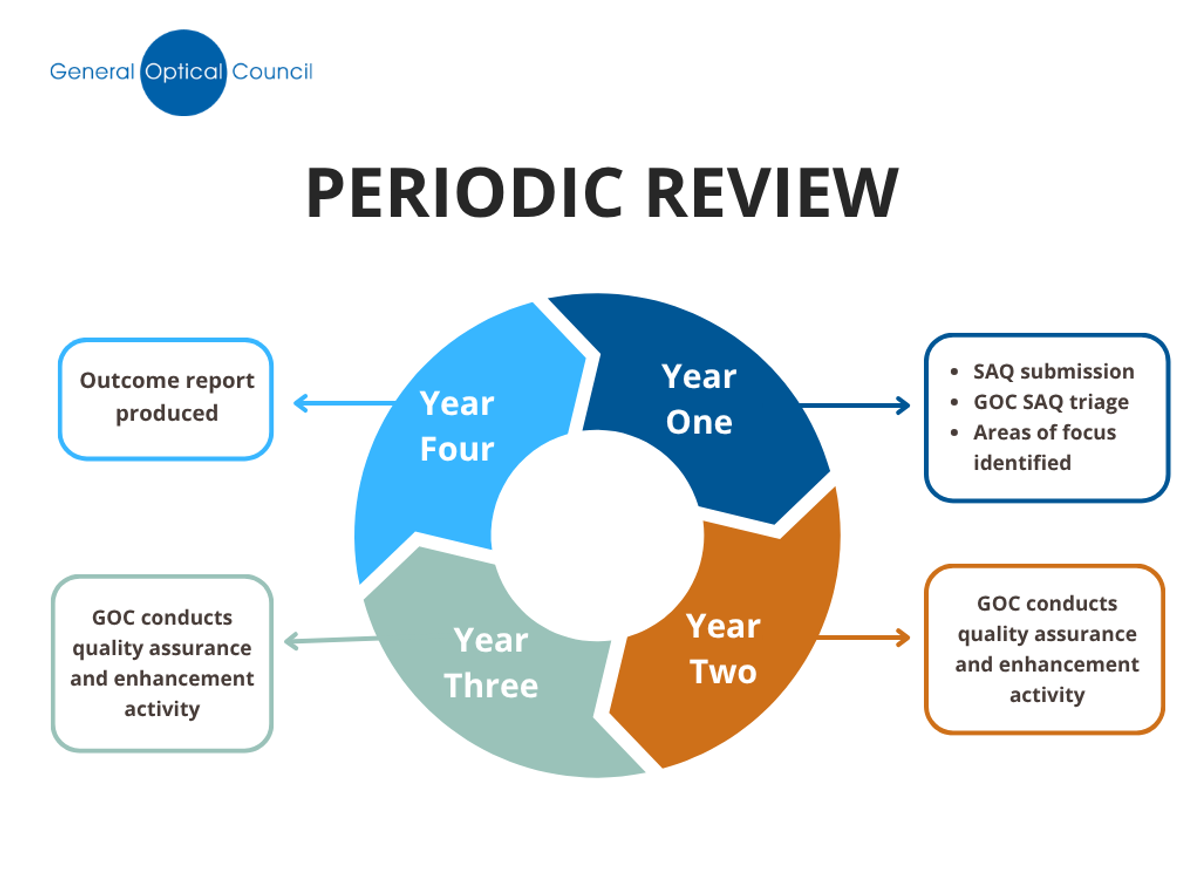
Periodic review cycle
Year one
Year one will see the education provider complete and submit its Self-Assessment Questionnaire (SAQ) to the Education Operations team via [email protected]. SAQ’s are specific to each specialty under the education and training requirements.
If you want to see an example of a SAQ, please email the Education team on [email protected].
Once received, the team, with support from Education Visitor Panellist (EVP) members, will triage the submission to establish what Quality Assurance and Enhancement Method (QAEM) activities will be undertaken during years two and three.
Years two and three
The agreed QAEM activities will take place in years two and three. The type and timings of each activity is dependent on various factors, including the level of assurance provided within the SAQ, considerations of risk, and level of concern. Each qualification will be subject to at least one to two activities in each year (years two and three).
Activities may include* one or more of the following:
-
In-person visits.
-
Desk-based activities e.g., a further information request or a request for a change/event notification to be submitted.
-
Observations e.g., observing practical assessments.
-
Surveys or questionnaires.
-
Meetings with stakeholders e.g., External Examiners or staff members delivering the qualification.
-
Annual Monitoring Return (AMR).
*This list is not exhaustive.
At the end of years two and three, QAEM activity reports will be produced and shared with the education provider. These will not be published.
Year four
It is unlikely a qualification will be subject to any further QAEM activities at this point. Instead, year four is intended to focus on findings, outcomes and producing the final report. The report will include details of the:
-
Qualification and provider/awarding organisation.
-
Overall findings including the number of conditions, recommendations, and areas of good practice.
-
QAEM activities undertaken including dates, who was involved, the nature of the activity and the findings.
-
Status awarded against each standard and whether further information or action is required from the provider/awarding organisation.
The final report will be shared with the provider/awarding organisation for factual corrections before being published on the GOC’s website.
Further information
Further information on the periodic review process can be found in our Periodic Review Q&A document and the education and training requirements.
For any additional queries or further information, please contact [email protected].
Annual monitoring return (AMR)
Education providers and awarding organisations are required to complete and submit an Annual Monitoring Return (AMR) form to the Education department.
Education providers and awarding organisations are provided the following guidance documents to aid completion of the AMR form:
The information provided is used to:
-
Support the development of the annual sector report.
-
Conduct analysis of individual qualifications to assess whether education providers continue to meet our requirements and/or standards.
Information submitted may also help inform risk stratification, the timing and specification of periodic review and the basis for our thematic and sample-based reviews.
Sector reports
The sector report provides a high-level summary of the outcomes of recent AMR cycles.
Individual qualification analysis
The Education Operations Team undertakes an internal triage for each separate qualification submission, which involves moderated reviews for all qualifications:
-
First review is completed by an Education Operations Officer.
-
Second review is completed by an Education Operations Manager.
-
Decision-making review is completed by the Head of Education and CPD.
Our Annual Monitoring and Return (AMR) Process Map explains the process for conducting the individual qualification analysis and outlines possible outcomes.
Data collection and use
You can review the Data Collection and Use document to understand how the GOC will use the data collected as part of the AMR.