
FTP Focus: Declarations for registrants
'FtP Focus: Declarations for registrants' was emailed to registrants on 29 July 2026. The copy as it appeared in the bulletin is below:
Hello, and welcome to another edition of FtP Focus. This issue looks at declarations: what optical professionals and businesses may need to declare, when they should do so, and what happens after a declaration is made.
Declarations are an important part of professional accountability. They help the GOC understand whether something may affect a registrant’s fitness to practise, train, or carry on business. Making a declaration does not automatically mean there is a fitness to practise concern, and many declarations require no further action. What matters is that registrants are open with us, provide relevant information, and take appropriate steps to manage any potential risk.
In this edition, we explain the types of matters that may need to be declared and how these declarations are considered by our Registration and Fitness to Practise teams. The three case studies in this bulletin show how different types of declarations may be assessed and how the Acceptance Criteria is used at the triage stage.
We hope you find this edition helpful. As always, we welcome your feedback and questions. You can reach us on [email protected]
Tom Eustice
Operations Manager (Triage)
What is a declaration?
A declaration is information that a registrant provides to the General Optical Council (GOC) about something that may affect their fitness to practise, train, or carry on business. It may relate to health, criminal matters, regulatory findings, ongoing investigations, practising while unregistered, or matters affecting an optical business. A declaration does not automatically mean there is a fitness to practise concern.
We look at each matter in context, considering factors such as:
- what happened
- how serious it is
- whether it is linked to optical practice or training
- what information is available
- what steps have been taken to manage any risk.
Being open and making a declaration promptly helps our teams decide whether further information is needed. It also demonstrates honesty, professionalism, and a commitment to safe practice – behaviour and values in line with our Standards of Practice.
What do I need to declare?
You must declare anything that could reasonably call into question your fitness to practise, train, or carry on business. For fully qualified and student registrants, the most common declarations are about health, criminal matters, regulatory or employer investigations, and practising while unregistered. For optical businesses, declarations are more likely to relate to the company, its directors, criminal or regulatory outcomes, current investigations, or whether the business remains fit to carry on business.
Health: You must declare a physical or mental health condition if it may currently affect your ability to practise safely. The GOC is not concerned with the diagnosis itself or whether the registrant has a disability. The focus instead is on the condition’s impact on safe practice, whether there is any risk to patients or the registrant, and what steps have been taken to manage that risk. Helpful information to provide when making a health declaration includes current treatment, medication, workplace adjustments, time away from work, occupational health advice, and a return-to-work plan.
Criminal matters: You must declare criminal convictions and cautions, unless they are protected under the relevant legislation. You must also declare current police investigations where they may lead to a conviction or caution.
Regulatory, employer or practice concerns: You must declare any finding by another UK or overseas health or social care regulator that your fitness to practise was impaired, and any current proceedings that may lead to that outcome. You must also declare investigations by an employer or educational institution where they relate to matters that may affect fitness to practise or training. For example, investigations about clinical errors, dishonesty, or concerns about health affecting practice or training. Practising while unregistered must also be declared.
Business declarations: Businesses must declare criminal or regulatory outcomes and current investigations involving the company or any of its directors. For example, a business being investigated by another regulator, a director receiving a relevant criminal conviction, and concerns that the business has allowed unregistered practice or failed to maintain appropriate systems for patient safety. Businesses are not required to make health declarations about their directors but, if a director is also a registered optometrist or dispensing optician, they may need to make a separate declaration as an individual registrant if a health or criminal matter, investigation, or regulatory finding may affect their own fitness to practise.
When should I make a declaration?
You must make a declaration as soon as you become aware of a matter that may affect your fitness to practise, train, or carry on business. This applies to fully qualified registrants, student registrants, and body corporate registrants.
Student registrants should consider whether a matter may affect their fitness to train, including their ability to meet the Standards for Optical Students during their training placement or supervised practice. Businesses should consider whether the matter may affect their fitness to carry on business.
If the matter arises outside the annual retention period, you should not wait until renewal to make the declaration.
Registrants can make a declaration through MyGOC or the declaration form available on our website at any time. If you are unsure whether something should be declared, you should consider the declaration guidance and seek advice from your employer, education provider, professional body, trade union, or legal or indemnity provider.
What happens when making a declaration?
When a declaration is made, we review the information to determine what should happen next. We may also ask for further information. Depending on the type of declaration made, this can include relevant dates, court documents, employer information, health information, and evidence of treatment or remediation.
If a declaration is made during the retention and registration period, the declaration is reviewed by the Registration team. The Registration team can decide that:
- the declaration requires no further action
- the declaration should be referred to Fitness to Practise for consideration
- more information is needed before a decision can be made.
Declarations made outside of the retention and registration period are considered by the Fitness to Practise team at triage.
For 2025–26:
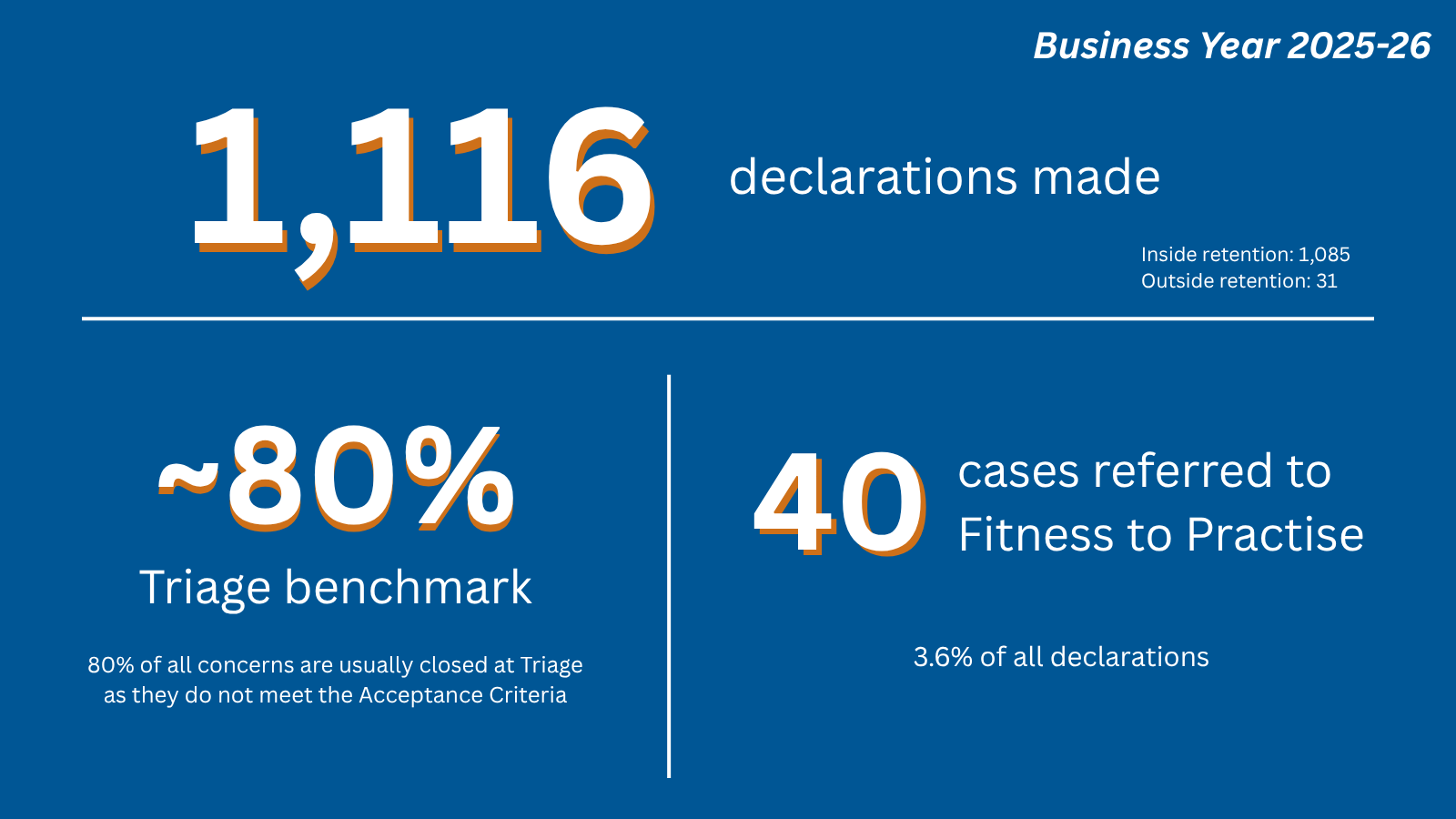
Of the 1,116 total declarations made during the 2025-26 registration year and outside the retention period, 40 were referred to Fitness to Practise by Registrations to be triaged. Of those 40:
- 22 were related to criminal matters;
- 10 were related to other investigations; and
- 8 were related to health.
At triage, concerns are assessed against the Acceptance Criteria to decide whether they amount to an allegation of impaired fitness to practise and should progress to formal investigation.
Usually, around 80% do not meet the Acceptance Criteria and are closed at triage.
Triage
If a declaration is referred to Fitness to Practise for consideration, the case is allocated to an officer in triage who will gather more information. The officer may make enquiries to clarify the facts, understand the current position, and assess any risk. Triage is not a formal investigation. Once the officer has gathered sufficient information, the GOC considers the concern against the Acceptance Criteria for registrants or for businesses to decide if a formal investigation should be opened.
We will consider the seriousness and extent of the concern, any action taken by the business to address it, whether any directors or registrants are involved, and whether the business continues to meet the standards expected of a registered optical business.
Acceptance Criteria
The Acceptance Criteria help the GOC to decide whether a concern raised should be investigated further. In around 80% of cases, the Acceptance Criteria are not met.
The main types of case that we consider under the Acceptance Criteria are:
Misconduct: The GOC considers whether the conduct could be regarded as reprehensible, deplorable, or otherwise sufficiently serious to call fitness to practise into question. This may include dishonesty, abuse of trust, serious breaches of the Standards, failure to declare relevant matters, or practising while unregistered. A grave one-off incident may meet the criteria, while less serious conduct may require repetition, aggravating features, or evidence of risk. The GOC considers context, intent, impact, insight, remediation, and whether the behaviour is linked to optical practice or wider public confidence.
Deficient professional performance: The GOC considers whether the concern suggests performance that is unacceptably low across a fair sample of the registrant’s work. This may include repeated clinical failings, poor record keeping, inadequate referrals, unsafe supervision, or repeated concerns raised by an employer. A single error will not usually be enough unless it is very serious or indicates a wider risk. The GOC considers whether the concern is supported by evidence, whether patients were or could have been affected, and whether the registrant has remediated.
Convictions and cautions: The GOC considers whether the registrant has received a conviction, caution, conditional offer, penalty agreement, or relevant order that may justify a fitness to practise allegation. Some criminal matters may raise public confidence concerns even where they happened outside work, while minor matters may not require further action.
Health: The GOC considers whether a physical or mental health condition is unmanaged or unacknowledged and whether it may create a risk to patients, the public, colleagues, or the registrant. The concern is not the condition itself, but its impact on safe practice. Relevant factors include insight, engagement with treatment, medical advice, occupational health input, adjustments, time away from practice, supervision, and whether there is evidence that the condition has affected clinical work or judgement.
Determination by another body: The GOC considers whether another UK or overseas health or social care regulator, or other relevant body, has made a finding that the registrant’s fitness to practise was impaired or imposed a restriction or sanction. The assessment considers the nature of the finding, the evidence, the outcome, whether the behaviour or impairment is relevant to optical practice, whether restrictions remain in place, and whether the matter indicates current risk or wider public confidence concerns.
Business concerns: Where the declaration relates to an optical business, the GOC considers whether the concern may affect the business’s ability to operate safely and meet the GOC’s Standards for Optical Businesses. This may include criminal or regulatory outcomes involving the company or its directors, failures in governance, concerns about unregistered practice, or systems issues that may put patients at risk. The GOC considers whether the concern appears isolated or systemic, what action the business has taken, whether any director or registrant is involved, and whether the business is able to comply with the Standards.
Investigation
If the Acceptance Criteria are met, the matter is opened as a formal fitness to practise investigation. The Investigations team will then gather relevant evidence, which may include information from the registrant, employers, courts, healthcare professionals, witnesses, supervisors, or other regulators. Opening an investigation does not mean the concern is proven, but that the available information suggests there may be an allegation of impaired fitness to practise that requires formal investigation. More information about how the GOC investigates fitness to practise concerns is available on our website
Case study 1
Speeding fixed penalty: declaration closed by the Registration team
During the retention window, a dispensing optician told the GOC that they received a speeding ticket after driving above the speed limit on the way home from work. They accepted a fixed penalty notice, paid the fine, and received penalty points. They did not attend court and were not convicted of an offence. They explained that there were no aggravating features, no alcohol or drugs, no dangerous driving, no injuries, and no link to patients or their optical practice.
Our declaration guidance confirmed that road traffic offences dealt with by fixed penalty notice, and without a conviction, do not usually need to be declared. There was no conviction or caution, no evidence of dishonesty, no patient safety risk, and no aggravating feature suggesting a public protection concern. The Registration team decided the declaration does not require any further action and can be closed. If the offence had resulted in a conviction, the concern would have been passed to Fitness to Practise for consideration.
Case study 2
Health condition: Acceptance Criteria not met, case closed
An optometrist declared that they have recently been diagnosed with a physical health condition affecting their vision and concentration.
The declaration was referred to triage because it relates to health and requires further enquiries. The officer made enquiries to understand the current impact of the condition, whether any patients were affected, and what safeguards are in place. The enquiries confirmed the registrant stopped practising as soon as symptoms affected their work, informed their employer, sought medical advice, and agreed a phased return with occupational health input. The registrant provided information about the diagnosis, treatment plan, medication, adjustments and expected return-to-work arrangements.
The key consideration was not that the registrant had a health condition, but whether it was unmanaged or unacknowledged and created ongoing risk. In this example, the registrant had insight, stopped working when needed, followed medical advice, engaged with occupational health, and agreed adjustments before returning to practice. There was no evidence of patient harm or unsafe practice. The GOC decided the Acceptance Criteria were not met and closed the matter.
Case study 3
Drink-driving conviction: Acceptance Criteria met, case opened
A registrant declared a conviction for drink driving after being stopped by police and found to be around three times the legal alcohol limit. The court imposed a driving disqualification and fine. The registrant said the incident happened outside work and did not affect their practice. However, the registrant did not notify the GOC until six months after the conviction.
As the matter involves a criminal conviction and significant alcohol use, it was referred to triage. The officer made enquiries with the court and employer. The employer reported separate concerns that the registrant had attended work smelling of alcohol and appeared unsteady during a clinic. Further information indicated the registrant had an alcohol-use disorder and had not yet engaged consistently with treatment. The concerns therefore go beyond the conviction alone.
The GOC considered that the conviction raised concerns about judgement, conduct, and public confidence in the profession. As there was also evidence of the registrant’s health affecting their practice and ongoing unmanaged risk to patients, the Acceptance Criteria were met both on grounds of conviction and on grounds of health. The GOC also considered the timeliness of the declaration and whether there was any indication that the registrant had failed to be honest and transparent about the matter. The GOC considered that the registrant’s failure to declare in a timely manner indicated misconduct and referred this for formal investigation, alongside the conviction and health concerns.