
FtP Focus: Supporting unrepresented registrants
'FtP Focus: Supporting unregistered registrants' was emailed to registrants on 19 November 2026. The copy as it appeared in the bulletin is below:
Hello and welcome to another edition of FtP Focus.
Being involved in a fitness to practise investigation or hearing can be a worrying and uncertain experience, particularly if you do not have legal representation or support from a professional body. The process can feel unfamiliar, and many registrants tell us they are unsure what to expect or where to turn for help.
This edition focuses on the support available to unrepresented registrants throughout the fitness to practise process. We begin by hearing from colleagues in our Investigations Team about what happens when a concern is investigated, the support available and how registrants can engage effectively with the process. Later in the edition, colleagues from our Hearings Team and members of the Fitness to Practise Committee share practical guidance on preparing for a hearing and understanding what to expect.
Our aim is to help registrants feel informed, supported and confident to engage with the process, whatever stage they are at.
We hope you find this edition helpful.
Vineeta Desai
Head of Hearing Operations
Participation of unrepresented registrants
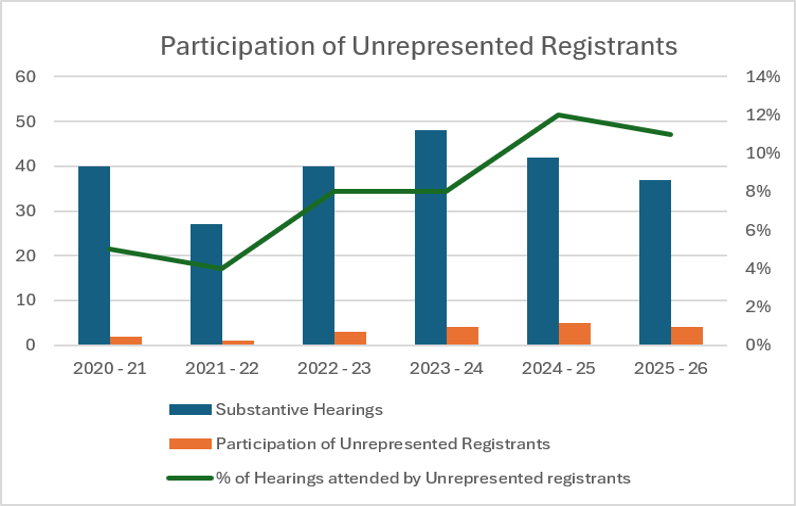
Supporting registrants to engage effectively with the fitness to practise process remains an important priority for us. The chart below shows the number of unrepresented registrants who participated in substantive hearings between 2020 – 2026.
While the overall numbers remain relatively small, participation has increased since 2022-23, reaching a peak of 12% in 2024-25 and remaining above pre-2023 levels in 2025-26.
The investigation stage
If your case is being investigated, understanding the process can help reduce uncertainty. Katri Kajava, Operations Manager (Casework), explains how investigations are managed and where registrants can find support along the way.
What happens after a case is referred to the Investigations Team?
If a concern is referred for investigation, it will be assigned to an Investigations Officer who will manage the case throughout the process.
The Investigations Officer will review the available information, identify any further evidence needed, and consider whether any support, reasonable adjustments or specific communication arrangements are required.
Once these initial steps are complete, you will be notified of the investigation and the concerns being considered. The Investigations Officer will then gather relevant evidence, which may include information from you, your employer, and other individuals or organisations connected to the case.
Throughout the investigation, the Investigations Officer will keep you informed of significant developments and explain any further information or documents required from you.
What updates are registrants entitled to receive and how often?
After we have notified you about the investigation, our usual practice is to send an update on the progress we have made every 12 weeks. Sometimes we do this more frequently, if asked to do so by a case party or if appropriate as the case progresses.
What can an Investigations Officer help with?
Investigations Officers play an important role in helping registrants understand the fitness to practise process. Their role is impartial and they can explain which stage a case has reached, clarify correspondence, answer procedural questions, and provide updates on progress.
However, they cannot provide legal advice, recommend how you should respond to allegations, or advise on what evidence should be submitted. Registrants who require legal advice should seek independent assistance from a solicitor, professional body, or another support organisation.
We recognise that you may feel anxious or uncertain about the process, particularly if you are engaging with it for the first time. Our role is to ensure you understand what is happening, and have access to the information and support you need.
What are the possible outcomes once an investigation is complete?
Once the investigation is complete, and you have had the opportunity to respond to the evidence in writing, the matter will be considered by case examiners.
Case examiners decide whether each complaint should be referred to the independent Fitness to Practise Committee. The case examiners may decide to:
- Take no further action. They may also provide advice about your future practice or conduct.
- Issue a non-public warning. We have separate guidance in relation to warnings.
- Refer the allegation to the Fitness to Practise Committee, which will usually hold a public hearing to decide what action to take. Read more about our hearings.
- Refer the case to the Investigation Committee if they cannot agree or if they require an assessment of your health or performance.
If the case is referred to the Fitness to Practise Committee for a hearing, we will prepare and share the relevant evidence and documents with you so that you understand the case and can prepare for the hearing. Our Hearings Team will then schedule the hearing.
What is your advice to unrepresented registrants going through this process?
We strongly encourage all registrants going through the investigation and fitness to practise process to seek independent legal support. A lawyer or other legal professional will better understand the fitness to practise process, making it easier for you to navigate.
We ensure that all unrepresented registrants are aware of all the various support options available to them. If we identify that a registrant is particularly vulnerable, we can also make direct referrals to the Independent Support Service rather than wait for the registrant to contact this service themselves. Should we have an immediate concern for a registrant’s safety and wellbeing, we may also contact the police asking for a welfare check to be carried out.
What to expect from a Hearing
If your case is referred to a hearing, it is understandable to feel uncertain about what happens next, particularly if you do not have legal representation. While hearings are formal proceedings, there is support available to help you understand the process and participate effectively.
In this section, we explain what happens before a hearing, who you are likely to meet, and what you can expect at each stage of the proceedings.
What is a hearing?
A hearing is a formal meeting, but it is run in a structured and respectful way. Most hearings are held online using Microsoft Teams. You can request an in-person hearing, which will usually take place at the GOC's offices in London. If you would prefer to attend in person, you should let us know as early as possible so that we can consider your request and make the appropriate arrangements.
The Fitness to Practise Committee is independent of the GOC and is responsible for considering the evidence and making decisions about the case. The Committee usually consists of:
- A Chair, who leads the hearing
- Two professionals from the registrant's field
- Two lay members who are not from the profession
Other individuals who participate in the hearing include:
- A GOC Case Presenter, who presents the case and explains the concerns being considered
- A Legal Adviser, who is independent from the GOC and provides legal advice to the Committee but takes no part in the Committee's decision-making
- A GOC Hearings and Scheduling Officer, who manages the hearing process and provides administrative support
You may choose to represent yourself at the hearing or seek representation from a solicitor, professional body, trade union representative, or another suitable person. Having representation can help you understand the process, prepare your case, and present your case during the hearing.
Why am I being asked to attend a hearing?
A hearing takes place when concerns about your practise need to be considered by an independent committee. The Committee will look at all the evidence and decide what action, if any, is needed.
This is your opportunity to:
- Tell your side of the story
- Respond to the concerns raised
- Help the Committee understand your situation
- Ask questions and raise relevant matters during the proceedings
Before the hearing
You will be supported by a Hearings and Scheduling Officer, who will be your main point of contact throughout the hearing process. They will:
- Explain the process and answer any questions you have.
- If you are not familiar with Microsoft Teams, explain the main features and provide written guidance.
- Check that you have all the documents you need for the hearing.
- Arrange a meeting on the morning of the first day of the hearing with the Legal Adviser, in the presence of the GOC Case Presenter, to explain the hearing process. They will not be able to give you legal advice.
- Discuss and arrange any reasonable adjustments you require.
What will happen on the day?
If you are attending a hearing for the first time, it is completely understandable to feel uncertain about what to expect. While every case is different, substantive hearings follow a structured process designed to ensure that all parties have a fair opportunity to present their case. A substantive hearing is a hearing where the Committee considers the evidence, decides whether the allegations are proved, and, if necessary, determines whether the registrant's fitness to practise is impaired and whether any sanction is required.
You may also be involved in other types of hearings during the fitness to practise process. Sometimes there may be an interim order hearing, which considers whether temporary restrictions are needed while a case is ongoing, or a review hearing, which considers whether an existing sanction or order should remain in place, be changed, or be revoked.
The Chair will guide everyone through each stage of the hearing, explain what is happening, and answer any procedural questions that arise.
Stage 1. Introductions and preliminary matters
The hearing will begin with introductions. The Chair will introduce the Committee members and everyone involved in the hearing, and explain their roles.
Before the case is considered, the Committee may deal with any preliminary matters, such as witness arrangements, legal applications, amendments to the allegations, or requests for part of the hearing to be held in private.
Stage 2. Facts
The Committee will first consider the factual allegations.
The GOC Case Presenter will present the evidence supporting the allegations and you will have the opportunity to respond, give evidence, ask questions, and call witnesses where appropriate.
Once all the evidence has been heard, the Committee will consider its decision in private and announce which facts, if any, it has found proved.
If no facts are proved, the case will end. If one or more facts are proved, the hearing will move to the next stage.
Stage 3. Grounds
The Committee will then consider whether the proved facts amount to a statutory ground, such as misconduct, deficient professional performance, adverse health, or a conviction or caution.
A statutory ground is one of the legal grounds set out in the Opticians Act 1989 that allows the Committee to consider whether a registrant's fitness to practise may be impaired. Before the Committee can go on to consider impairment, it must first be satisfied that at least one statutory ground has been established.
Both parties will have an opportunity to make submissions before the Committee reaches its decision.
Stage 4. Impairment
If a statutory ground is established, the Committee will consider whether your fitness to practise is currently impaired.
The Committee will consider whether there are concerns about your ability to practise safely and effectively, or whether action is needed to maintain public confidence in the profession and uphold proper professional standards. It will focus on your current circumstances and whether any risk or concerns remain at the time of the hearing.
This is your opportunity to explain any insight you have developed, steps you have taken to address the concerns raised, and any remediation or learning you have undertaken in response.
If the Committee decides that your fitness to practise is not impaired, a warning may be considered. If it finds impairment, the hearing will move to the sanction stage.
Stage 5. Sanction
If impairment is found, the Committee will decide whether a sanction is necessary and, if so, what action should be taken.
Possible outcomes include:
- No Order – this means the Committee has decided that no further action is required and you can continue to practise without any restrictions
- Conditions of Practice Order
- Suspension Order
- Erasure
- Financial Penalty Order
Remember
Not every hearing progresses through all five stages. The outcome at each stage determines whether the hearing continues onto the next stage. Throughout the process, the Chair, Legal Adviser, and Hearings and Scheduling Officer will ensure that procedures are explained clearly and that everyone has a fair opportunity to participate.
Meet the people behind the process
While support from GOC staff is important, the hearing itself is managed by an independent Fitness to Practise Committee. We spoke with Adrian Smith, Chair of the Committee, about how Committees support registrants who attend hearings without legal representation and the steps taken to ensure proceedings remain fair and accessible.
"There is no trickery or game-playing in this. The Committee will always do its best to reduce unnecessary anxiety and ensure everyone has a fair opportunity to present their case."
Adrian Smith, Fitness to Practise Committee Chair
Interview with Adrian Smith, Fitness to Practise Committee Chair
Having taken early retirement from the probation service, after gaining over 30 years of experience, Adrian initially set up a management consultancy business. This soon developed into a portfolio of posts in professional regulation, including with the General Dental Council, Nursing and Midwifery Council, Social Work England, and as an independent member of police misconduct panels. Adrian has now been involved in adjudication for over 12 years and has been chairing since 2017. He joined the GOC's Fitness to Practise Committee in December 2024.
From a Chair’s perspective, what are the main challenges that can arise when a registrant attends a Fitness to Practise hearing without legal representation?
An unrepresented registrant does not have the benefit of legal advice and support throughout the hearing, and is therefore more likely to struggle to understand and follow the somewhat complicated procedures of a hearing. This can be particularly daunting for a registrant who is attempting to represent themselves. They will wish to present their case as clearly and eloquently as possible, but this is not easy to do, especially when nervous and confused about process.
What practical steps do you take as Chair to help an unrepresented registrant understand the process and feel able to participate effectively?
I will always take the opportunity to begin the hearing with a spoken recognition that the registrant is unrepresented. I will encourage the registrant to feel free to ask questions if they are struggling to follow the proceedings and will manage the hearing at a slower pace if necessary. After all, the Committee is invested in enabling the registrant (and indeed all witnesses) to provide their ‘best’ evidence so that it can adjudicate on the full facts of a case. There is no trickery or game-playing in this – the Committee will always do its best to reduce unnecessary anxiety and ensure everyone has a fair opportunity to present their case.
Another very important practical step is that at each key stage of the hearing, I will encourage meetings between the registrant, the case presenter, the Committee’s Legal Adviser, and the Hearings and Scheduling Officer. This provides the Legal Adviser with the opportunity to explain the process and outline the task-in-hand. These meetings often prove invaluable in helping the registrant to negotiate the hearing.
How do you ensure that the Committee’s questions and decisions are clear and accessible to an unrepresented registrant?
With an unrepresented registrant, the Committee will take the opportunity to meet privately and consider whether there are any additional questions that would help clarify the evidence. We will explore how to best pose these in a way that can be easily understood by the registrant before returning to the hearing room. I would again make the point that our aim is to obtain the ‘best’ evidence from all parties, so it is important to us that all of our questions are simple and clearly stated.
Are there particular moments in any GOC hearings where unrepresented registrants are more likely to need additional support or clarification?
Probably the most challenging part of the process is when an unrepresented registrant is invited to question a witness. There is a particular skill in this, particularly when cross-examining, which barristers spend years perfecting. I often find that I need to remind registrants that they must stick to asking questions rather than slipping into making statements or accusations. Sometimes it is helpful to invite the Committee’s Legal Adviser to explain this part of the process to the unrepresented registrant. This might involve a meeting between the parties, the Legal Adviser, and the Hearings and Scheduling Officer.
Occasionally, where a registrant is really struggling, I will invite the Legal Adviser to ask questions of a witness, on behalf of the registrant. They will do this strictly in their independent role. When this happens, it is a further example of the committee’s determination to provide every opportunity to secure ‘best’ evidence.
What advice would you give to an unrepresented registrant who is preparing to attend a hearing without representation?
Take time to prepare what you wish to ask witnesses and stick to questions rather than making statements. Remember that at each stage of the proceedings you will have the opportunity to prepare statements, which in this context are known as ‘submissions’. It is worth writing these down in draft from the beginning in response to the evidence which has emerged during the hearing. You can then amend them later as the hearing progresses.
Remember to stay polite and remain patient. Sometimes you will hear statements or submissions that you don’t agree with, but you will be provided with the opportunity to have your say in due course. It might help to remind yourself that the Committee is committed to making the right decision on the facts, misconduct, impairment, and sanction, should the case reach those stages. That means delivering a respectful and inclusive environment which provides you with every opportunity for you to present your case.
Legal Advisers play a key role in supporting effective participation. While they cannot provide registrants with legal advice, they help explain procedures and ensure registrants understand what is happening at each stage of the hearing. We spoke to Kelly Thomas about common challenges faced by unrepresented registrants and how Legal Advisers support the hearing process.
Interview with Kelly Thomas, Legal Adviser to the Fitness to Practise Committee
Kelly Thomas is a First-tier Tribunal Judge, Legal Adviser to the General Optical Council, and a Legal Trainer. Having spent more than two decades in criminal law before moving into judicial and regulatory roles, she has extensive experience of adjudication, professional discipline, and regulatory decision-making. She advises Fitness to Practise and Registration Appeals Committees and delivers specialist training in law, evidence, procedure, and decision-writing.
What is the Legal Adviser’s role in hearings when a registrant is unrepresented, and how does this differ from the role of the Chair or Committee?
The Legal Adviser would be responsible for taking the unrepresented registrant through the procedure just before each stage of the hearing starts. I’ll explain in simple terms what the GOC position is, and what the Committee would expect to be addressed in response. Often, it would involve an empathetic approach, and will allow registrants to have the process explained in simple terms in a more private setting, without the pressure of all the hearing members being present. The Chair's role is to ensure fairness and, whilst they are likely to take things more slowly and to not use legal jargon, the Chair would not be expected to break down each stage. Neither of us must give any legal advice to the registrant.
What are the most common difficulties unrepresented registrants face during GOC Fitness to Practise hearings?
Not understanding that everyone gets a turn. Sometimes they want to interrupt when they don't agree with the GOC submissions, and it must be hard to hear accusations they feel to be false and not to react. Another challenge is when they are not able to obtain funding and the sense of injustice they might feel from having to represent themselves. Finally, not knowing when to stop - sometimes they make their points, and do so very well, but continue to repeat them.
What examples of good practice have you seen in hearings involving unrepresented registrants? How did they support fairness and effective participation?
Keeping an eye on the registrant during the hearing. I had one hearing where most people in the room were busy taking notes and had not spotted that the registrant had become very emotional. The Chair noticed this and offered a break for everyone. It was done in a kind way without singling out the registrant, but ensuring they had time to calm down before continuing. I also find that explaining each stage of the process, and what is coming next, really helps registrants feel calmer.
As part of your role, you are responsible for drafting the Committee’s decision. How do you ensure that this is clear and accessible for unrepresented registrants?
Simple language and no legal jargon. If there are any unavoidable legal words, I would encourage the Committee to include an explanation.
What advice would you give to an unrepresented registrant who is preparing to attend a hearing without representation?
- To obtain legal advice if at all possible. If not, to look at the Hearings and Indicative Sanctions Guidance first as an overview of the Committee's guidance.
- To look at the paperwork sent and understand each stage of the hearing.
- To look at the GOC’s position and papers and really understand the allegations so that they are able to respond effectively.
- To take up the opportunity to meet with the Legal Adviser just before the hearing starts and ask any questions you might have.
Five tips for unrepresented registrants
Throughout this edition, colleagues have highlighted the importance of preparation and engagement. Natasha Bance, Hearings and Scheduling Officer, shares five practical tips to help registrants prepare for and navigate a hearing without legal representation.
1. Attend your Case Management Meeting
Once a Case Management Meeting (CMM) is scheduled ahead of your substantive hearing, do attend it if you can. It is a valuable opportunity to understand the hearing timetable, discuss the allegations, raise concerns about documents or witnesses, and identify any support or reasonable adjustments that you may need. Registrants who engage early often feel more prepared and confident when the hearing starts.
2. Give yourself time to prepare
Take time to familiarise yourself with the GOC’s documents and make a note of important page numbers that you may wish to refer to during your hearing. If you intend to submit your own documents for the Fitness to Practise Committee's consideration, ensure that they are provided by the relevant deadline. The Hearings Team will send reminders about upcoming deadlines and can assist with any practical queries about submitting documents. Being organised and meeting deadlines can help you to focus on presenting your case during the hearing and ensure that proceedings run smoothly.
3. Review your Notice of Hearing
The Notice of Hearing (NOH) will be sent to you at least 28 days before your hearing. For Interim Order Applications and procedural hearings, your NOH will be sent to you at least 7 days before. Your NOH contains important practical information about your hearing, including the start time, whether it will take place in person or remotely, and any relevant venue or joining details. If you are attending in person, it may be helpful to plan your journey in advance. If you are attending remotely, consider testing your equipment beforehand to ensure that you can join without difficulty. Your Hearings and Scheduling Officer will provide guidance on using Microsoft Teams and can arrange a test call if you would find one helpful.
4. Allow time for careful decision-making
Throughout your hearing, the Committee will retire at various stages to consider and draft their decisions. While these breaks can sometimes feel lengthy, they are a normal and important part of the process that helps to ensure all issues are given careful consideration before decisions are reached. Registrants are encouraged to be patient during these breaks, as the time taken helps to support a fair and careful outcome.
5. Ask for help
If you have any questions about the process, your Hearings and Scheduling Officer is there to help. They can explain the hearing process, timings, and what will happen next. Additionally, the Legal Adviser will meet with you on the morning of your hearing and is available throughout to answer questions relating to procedure. For further support, a leaflet designed to support registrants appearing before the Committee at a substantive hearing without legal representation will soon be available on our website.
Where can I find support?
Throughout the hearing process, registrants often contact the Hearings Team with questions about what to expect and where they can find support. Bernice Yeboah, Hearings Administrator, outlines the support available to those navigating the process without legal representation.
The GOC understands that hearings can feel daunting, particularly if you are unrepresented. The Hearings Team is committed to supporting you before, during and after the hearing process. While we cannot give legal advice, we can explain the process, answer procedural questions, and help you understand what to expect.
If you are not a member of a union or representative body, there are organisations that can offer support. Below is a range of specialist organisations who can offer confidential advice, emotional support, and advocacy, which you may find helpful.
- Advocate
- Citizens Advice
- The GOC's Independent Support Service
- NHS Practitioner Health
- AOP Peer Support Line
- ABDO and FODO
- Professional bodies and trade unions