
FtP Focus: Triage and the OCCS
'FtP Focus: Triage and the OCCS' was emailed to registrants on 30 July 2025. The copy as it appeared in the bulletin is below:
Hello, and welcome to another edition of FTP Focus. This issue discusses the role of our Triage Team, who assess all the concerns we receive at the GOC and decide if further investigation is required. This includes self-referrals from registrants and complaints sent in by patients and the public, employers, or other bodies.
We introduced an enhanced triage process in 2019. Its wider scope gives us discretion to close cases at an earlier stage, where there’s no ongoing risk to the public. This means that cases are not opened against registrants when they don’t pose a risk, and it ensures we have sufficient resources to investigate those that do.
The Acceptance Criteria guide us in deciding which referrals amount to an allegation where a registrant’s fitness to practise, train, or carry on business may be impaired. If the threshold is met, the case will progress for an investigation.
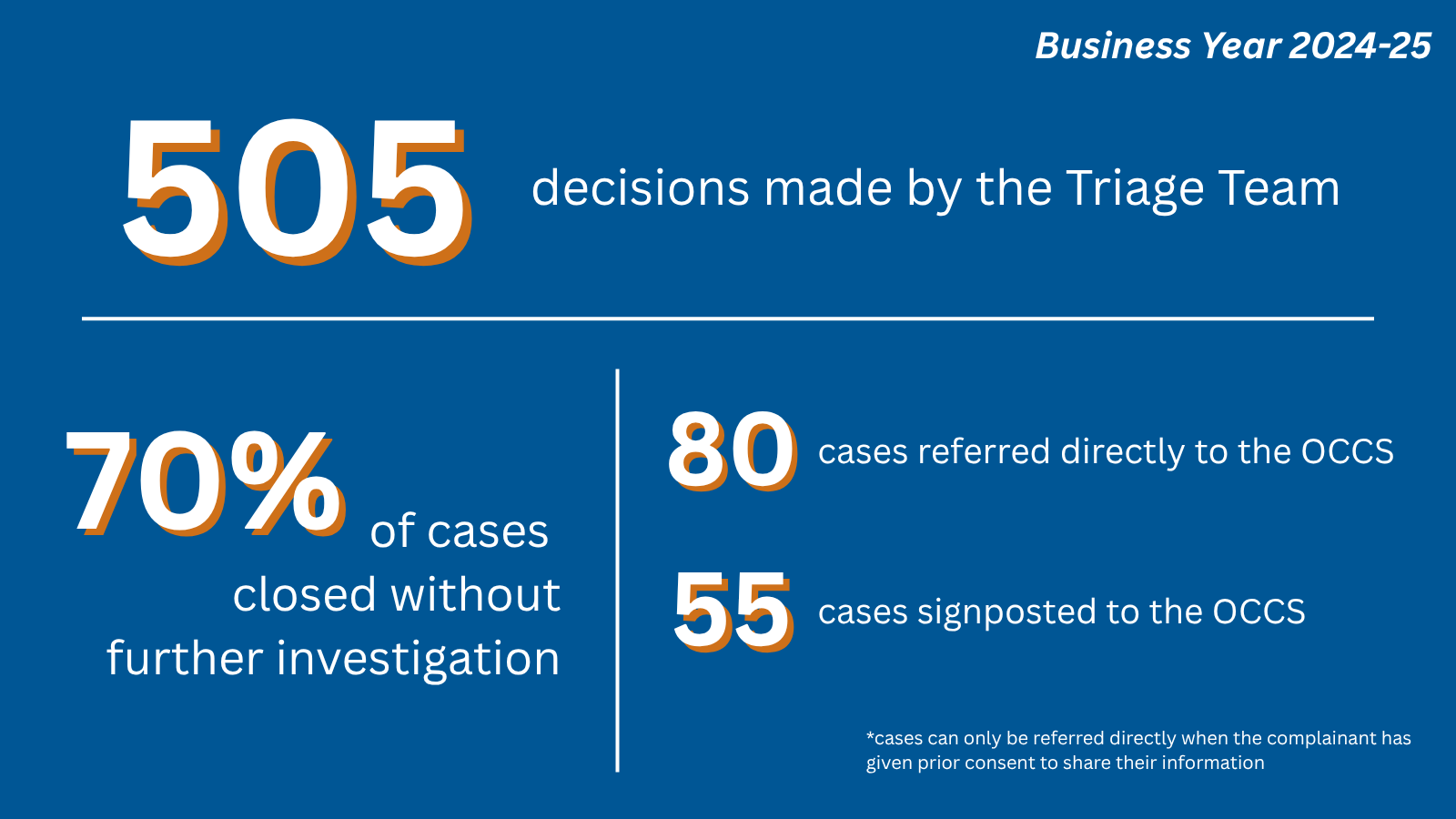
To illustrate how effective the triage process is, the GOC made 505 decisions in the 2024/2025 business year and 70% were closed without further investigation.
This edition of FtP Focus features an interview with Paul Chapman-Hatchett, who recently joined the Optical Consumer Complaints Service (OCCS) as an optical adviser. You’ll also find some interesting case studies that demonstrate how co-working between the GOC and OCCS at this initial stage serves to benefit everyone, including our registrants.
The Optical Consumer Complaints Service is an independent and free mediation service for consumers of optical care and the professionals providing that care. As you’ll see from Paul’s comments, the OCCS can facilitate a satisfactory and fair resolution to individual complaints. They can also help by sharing best practice with optical professionals to avoid and manage complaints effectively.
We often receive complaints that don’t fall under our fitness to practise remit, and more closely resemble consumer disputes. We can close these in a timely way by directing patients to the OCCS for more relevant help, such as with refund requests or questions about the service or product they received. We continue to find this is a mutually beneficial and proportionate process for everyone involved.
We hope you enjoy this bulletin, and I look forward to sharing more with you next time.
Carole Auchterlonie
Acting Director of Regulatory Operations
Interview with Paul Chapman-Hatchett
Hi Paul. Thanks for talking with us. To start, what is your background in the optical sector?
I founded a domiciliary optical practice based in the southeast of England in 1995, which grew into a nationwide chain of franchised domiciliary practices. As CEO, I used my professional and personal skills to lead a customer-focused and innovative business. I sold and exited the optometry business in 2021 and became more engaged with optical bodies. This included roles as co-chair of the Domiciliary Eye Care Committee, the inaugural AOP domiciliary optometrist councillor, and being elected to the Association of Optometrists (AOP) board in 2024.
In 2023, I founded Mottainai Solutions, where I serve as a director and executive leadership adviser. I am also a non-executive director and clinical adviser at two MedTech startups, providing strategic direction, and governance and clinical advice. In 2025, I was invited to serve as the clinical adviser for the OCCS. This role aligns with my strong commitment to customer service and extensive understanding of the role optometrists play in all aspects of optical care in the UK.
Can you provide an overview of your role at the OCCS?
This role is dedicated to bridging the gap between clinical expertise and consumer rights, ensuring fairness and professionalism in handling consumer complaints. It involves providing impartial clinical guidance to uphold professional standards while collaborating with optical groups, independent practices, and professional bodies to mediate consumer concerns. Additionally, it supports professional development through CPD, empowering professionals with the confidence to effectively manage and resolve consumer issues.
Have you noticed any common complaints about GOC registrants’ conduct recently?
The most common concerns we receive revolve around differences in the expected and experienced outcomes of consumers when they have purchased new spectacles. For the most part, this leads to a request for an acknowledgement and apology from the practitioner that the consumer’s experience has not lived up to their expectation. Many of these consumers are also asking for a refund.
Our second most common concern tends to revolve around consumers’ interactions with staff at the practice. These negative interactions can occur at any stage of a consumer’s journey with the practice, including their telephone manner, meet and greet, during aftercare, and when talking with the optometrist, especially when optometrists are articulating their recommendations to the consumer after the eye examination.
Consumers also contact us about the products they receive, primarily spectacles or contact lenses. While the first two areas of concern often result in the OCCS supporting a resolution through mediation, most issues with products are resolved by ensuring the consumer returns to the practice with suitable expectations for a possible outcome.
Is there any training or CPD you would recommend that might assist registrants in these areas?
We complete a significant amount of CPD for GOC registrants. The CPD is aimed at helping them to develop better understanding of how to manage complaints, by giving them a strategy to apply when a consumer raises a concern. The confidence they gain in how to manage these situations creates a positive and proactive environment which helps the practitioner and consumer to find a mutually acceptable solution as quickly as possible, reducing anxiety and inconvenience on both sides.
Are GOC registrants required or encouraged to engage with your mediation?
GOC registrants are not required to engage with the OCCS. However, we actively encourage registrants to make use of OCCS support, and many will recommend that consumers contact us, especially if they may struggle to resolve the concerns themselves. The feedback we get from both practitioners and consumers is that an impartial mediation service really helps both parties to find common ground and therefore an acceptable resolution. This is evidenced by the fact that only 2% of all the complaints we receive do not conclude in a successful mediation. This is something we are very proud of and reflects the trust that we build with both parties, ensuring that a fair and equitable solution is found
What can registrants do to help patients and reduce the risk of them raising a complaint with the OCCS?
We all must acknowledge that, as a society, we are more likely to raise concerns about a service we receive than ever before. The GOC Public Perceptions research 2025 found that just over one in ten (12%) of consumers complained or considered complaining about their experience at an opticians/optometrist practice. Gaining a detailed understanding of why and where things might not have lived up to the consumer’s expectations is critical. We encourage registrants to listen to the consumer, acknowledging the distress and inconvenience they may have experienced, and then reassure them of the steps you will take to try and resolve the issue as smoothly and quickly as possible. It is crucial to ensure the consumer has confidence you will own the complaint and deliver on the assurances you have made. Finally, always consider that you are lucky they have come back to raise their concerns and are giving you a chance to resolve the issues. If you do this successfully these consumers will often become your biggest advocates, so look at a complaint as an opportunity.
Statistics - how many cases went through the triage process last year?
In the business year 2024-25, the Triage Team made 505 decisions on finess to practise referrals. 70% of cases were closed without further investigation, of which 80 were referred directly to the OCCS and 55 signposted. The GOC can only refer a case to the OCCS directly if the complainant has previously consented to their information being shared with the service. If consent has not been given, but the Triage Team feels the complainant may benefit from the OCCS' support, they can still signpost them to the service.
Case studies
Case study #1: Patient complaint about an inaccurate prescription
Referral
A patient attended their local optical practice for an eye test. They later said that the prescription they were given for reading glasses was inaccurate. They raised this with the practice, and a different prescription was given without a retest. The patient found this was too strong, but the practice responded that they should take time to get used to it.
The patient contacted the practice 12 months later and was re-examined. An accurate prescription was achieved this time that proved the previous one incorrect. The patient wanted help getting a full refund; only a partial one had been offered.
Triage review
As a prescription non-tolerance issue, the concerns did not meet our Acceptance Criteria threshold. Additionally, it is beyond our remit to help with refund requests.
Outcome
Our triage assessment did not identify any clinical issues that might raise public protection or public interest concerns, and this was an isolated incident that did not place the patient at risk of serious harm. At 1.6 of the Acceptance Criteria, it outlines that some complaints are better dealt with by other bodies, including consumer matters by the OCCS. The OCCS have a wider range of resolution channels that may resolve certain complaints more appropriately, like this patient’s request for a full refund. To help the patient and optical practice, the case was closed and referred to the OCCS to mediate and attempt to achieve a satisfactory resolution.
Case study #2: Patient’s parent complaint about an inaccurate prescription and failure to refer a possible condition
Referral
A parent took their child to an optical practice where it was found they had a +2 prescription in their left eye and +4 in their right. The optometrist said they would contact a hospital about concerns they had for the patient’s right eye, specifically in relation to amblyopia. When they returned for a retest with a different optometrist five months later, the patient’s sight was said to have improved, and a different prescription was given.
The patient attended a hospital approximately seven months after the second appointment. An ophthalmologist there determined that the prescription had not been amended, and the patient was still using the same one they were given at the first appointment. The parent was concerned their child may suffer lasting damage to their sight due to this error.
Triage review
Given the potential seriousness of this case, we requested the patient’s records and asked one of our optical advisers for their assessment. Contrary to the complainant’s account, the optical adviser said hospital referrals were submitted by the optometrists after both appointments and attempts were made to communicate with the parents and keep them informed. No failure was identified in the actions of the second optometrist, who had referred the patient because of their change in vision. The decision to alter their glasses was communicated and considered reasonable in accordance with their test results.
Outcome
We reviewed the optical adviser’s comments and concluded there was no allegation of impaired fitness to practise. Neither registrant involved in the patient’s care presented an ongoing risk to patient safety, though we did refer the case to the OCCS. This additional step allowed the OCCS to use mediation to help the patient’s parent understand what had happened.
Case study #3: OCCS referral of a patient who was diagnosed with a cancerous tumour
Referral
The OCCS were contacted by a patient asking for help with concerns about the clinical treatment they received and the optical business’s subsequent response to their complaint. The patient attended the practice experiencing double vision. The optometrist did not identify any serious concerns but said they would refer the patient to their GP in relation to a droopy eyelid.
The patient chased the referral and found that it had not been submitted. They contacted the GP themselves and were referred to hospital where a tumour was detected.
The optometrist and business owner complied with the OCCS’s request for them to respond further to the patient’s correspondence. In their letter, the optometrist apologised to the patient and offered an explanation as to why an urgent referral was not thought necessary at the time, and why the routine referral was not processed (an administrative error involving the spelling of the patient’s name).
Triage review
The OCCS referred this to us due to the potential fitness to practise allegations arising from this failure to detect and refer a malignant tumour. We identified the optometrist and found that they had recently retired, so they were no longer on the register. We also identified the business, which has since changed ownership. In the optometrist’s letter to the patient, they said they had ensured that the business was clear on how future complaints should be managed.
Outcome
The GOC has no remit to investigate an unregistered individual, so the case closed. A note was added to the optometrist’s profile to ensure we reconsider the matter if they ever reapply to the register. In that event, an optical adviser would review the eye test records to determine if the optometrist should have detected the condition and processed an urgent referral.
In cases such as this, we may also consider the fact that the optometrist had a long career without any other fitness to practise history.
We also assessed the conduct of the business registrant. We were not aware of any other allegations, and, given the change in ownership and understanding that they were committed to managing future complaints more effectively, no further action was taken.
The complainant could go back to the OCCS for help with mediation if they wanted a further explanation and/or apology.
Useful links
We hope you found this bulletin informative. Please contact us on [email protected] for any queries, comments or suggestions.